
⚖️ Topic: Body composition science · Deurenberg et al. (1999), International Journal of Obesity
Body Mass Index (BMI) has been the go-to measure for assessing body weight for quite some time. It's a straightforward calculation: weight divided by height squared (kg/m²). Many people assume this simple formula accurately reflects body fat percentage (%BF). 📏
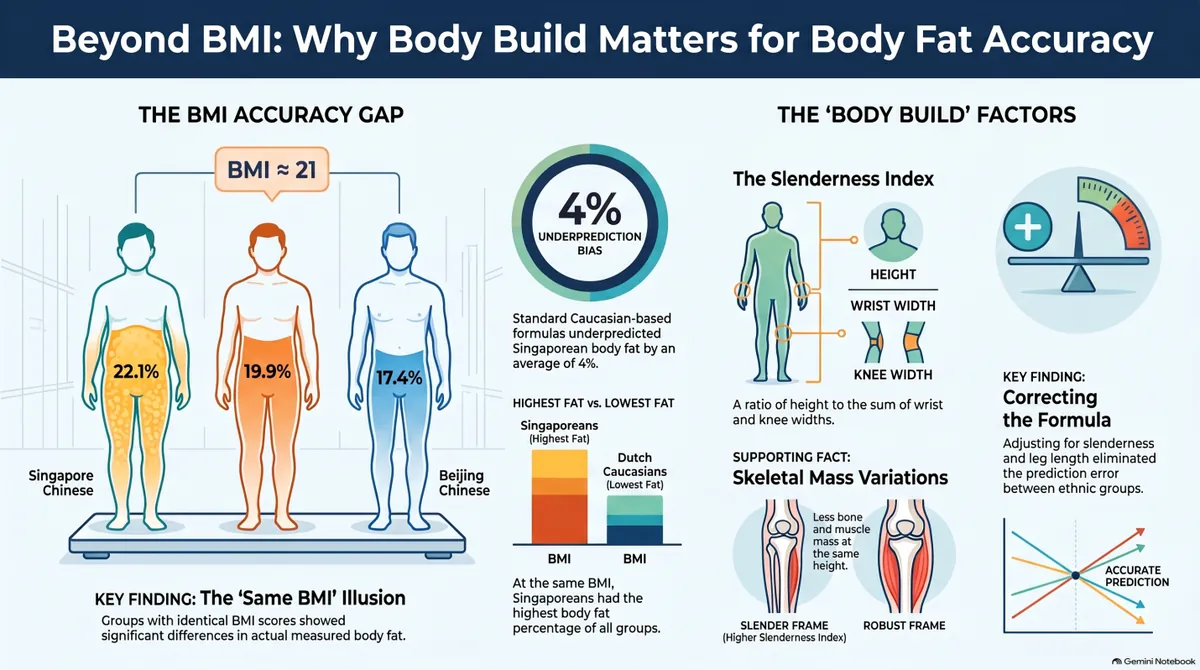
However, groundbreaking research in biometrics has uncovered a significant flaw in depending solely on this height-to-weight ratio. Two people who are the same age, gender, and BMI can have vastly different body fat levels based on their skeletal structure and overall body composition.
🦴 The missing piece
The missing piece in standard health assessments is structural anatomy. Differences in skeletal frame size, bone density, and body proportions can greatly influence how much fat someone carries, even if their BMI is identical.
📊 The Metric We All Rely On—and Its Shortcomings
When researchers used a standard Caucasian prediction formula to estimate body fat based on BMI, the results were spot on for the Dutch and Beijing groups, but they missed the mark in Singapore. For the Singapore cohort, the formula underestimated body fat by an average of 4.0 ± 0.8% (mean ± s.e.m.) when compared to the Dutch baseline.
4.0 ± 0.8% UNDERESTIMATION IN SINGAPORE |
3 POPULATIONS COMPARED |
|---|
This consistent underestimation poses a significant clinical health risk. Relying only on standard BMI thresholds can mask high levels of body fat—often referred to as "skinny fat"—in populations with smaller frames, leaving metabolic risks unnoticed even when the scale shows a "normal" weight. ⚠️
🔬 Rethinking How We Measure Human Health
Body Mass Index (BMI) is often seen as a simple height-to-weight ratio, but it really falls short by ignoring important factors like skeletal frame structure, bone density, and limb proportions. For instance, individuals with slighter frames naturally have less structural bone and muscle weight, which means that the standard BMI calculations can lead to a misleading picture of body fat across different body types.
✅ Bottom line
To get a more accurate understanding of human body composition, future diagnostic tools and epidemiological screenings need to include objective measures of frame size and body proportions.
References
- Deurenberg, P., Deurenberg-Yap, M., Wang, J., Lin, F. P., & Schmidt, G. (1999). The impact of body build on the relationship between body mass index and percent body fat. International Journal of Obesity, 23(5), 537–542.