
📘 Based on: Semnani-Azad et al. (2025) network meta-analysis · BMJ · 99 RCTs, 6,582 adults
Let's dive into the fascinating world of "Intermittent Fasting Strategies and Cardiometabolic Outcomes: A Network Meta-Analysis." Here we explore how different intermittent fasting methods can impact our heart health and metabolic functions. ⏱️
By analyzing various strategies, it sheds light on the potential benefits and outcomes associated with these fasting techniques. Whether you're curious about improving your health or just want to understand the science behind it, this analysis offers valuable insights into how intermittent fasting can play a role in cardiometabolic wellness.
99 RANDOMIZED CLINICAL TRIALS |
6,582 ADULTS STUDIED |
24 wks WHERE BENEFITS CONVERGE |
3 FASTING CATEGORIES COMPARED |
|---|
A recent systematic review and network meta-analysis looked at 99 randomized clinical trials with a total of 6,582 adults to compare the health impacts of intermittent fasting, continuous energy restriction, and ad-libitum diets. The researchers found that all these structured dietary methods effectively led to weight loss when stacked against an unrestricted ad-libitum diet.

Interestingly, alternate day fasting showed some modest weight loss benefits over continuous energy restriction and other fasting methods, especially in studies that were shorter in duration. However, the advantages of these specific diet strategies tended to fade in moderate-to-long-term trials that lasted 24 weeks or more.
🏁 Bottom line
The results suggest that both intermittent fasting and continuous energy restriction offer similar cardiometabolic benefits for managing weight over the long run.
🧭 What Is Intermittent Fasting, Really?
Intermittent fasting (IF) is more about when you eat rather than what you eat. It's a unique approach to dieting that focuses on the timing of your meals instead of just counting calories or obsessing over specific nutrients. Unlike traditional weight-loss methods that rely on Continuous Energy Restriction (CER)—which means cutting calories consistently every day—intermittent fasting allows you to enjoy your food in designated eating windows followed by periods of fasting.
At its essence, intermittent fasting involves alternating between times of fasting or limited calorie intake and times when you can eat normally or even freely. Depending on the method you choose, your fasting periods can vary from a few hours each day to entire 24-hour days spread throughout the week.
📖 Key Concepts
🔁 Intermittent Fasting (IF): This approach includes set times for fasting or limited calorie intake, mixed with times for normal eating without restrictions.
🍴 Ad-libitum Eating: This is your typical eating style where you consume food based on your hunger cues, without worrying about calorie limits.
📉 Continuous Energy Restriction (CER): This is the traditional dieting method that emphasizes a constant daily reduction in calories without any fasting breaks.
🩺 Clinical Spectrum of "Fasting": In the context of research and clinical studies, a "fasting period" doesn't just mean complete abstinence from food (like only drinking water). It can also refer to a modified approach where you consume a small amount of calories—typically around 20–25% of your daily needs, which is about 500–600 calories.
🗂️ Types of Intermittent Fasting
1️⃣ Time-Restricted Eating (TRE) — Intra-Daily / 24 Hours
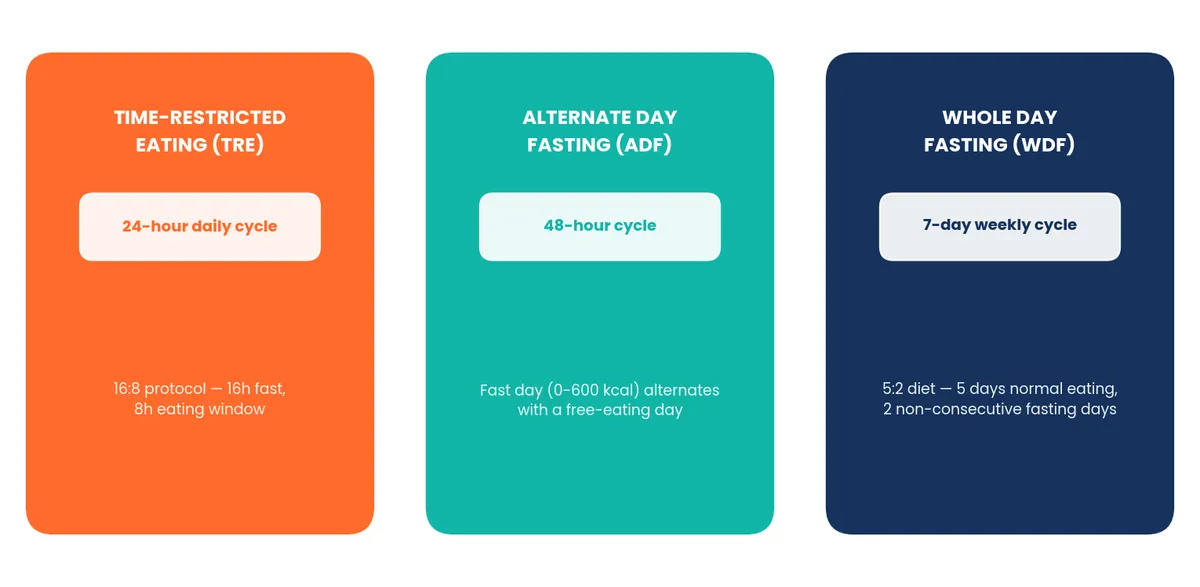
Time-Restricted Eating (TRE) is a form of intermittent fasting that works within a straightforward 24-hour daily cycle. Instead of changing eating habits from one day to the next, TRE splits each day into two clear segments: a block of fasting hours and a block of non-fasting hours. The beauty of this approach lies in its simplicity, making it easy for people to sync their eating patterns with their daily routines and natural body clocks.
Cycle Duration: 24 hours (repeats continuously every day)
Fasting Period: A specific number of consecutive fasting hours each day (which can involve complete or modified energy restriction)
Eating Window: The remaining hours of the day set aside for non-fasting or free eating
Canonical Example: The 16:8 protocol, which features a continuous 16-hour fasting period followed by an 8-hour window for unrestricted eating every day
📝 Learner checkpoint
With TRE, daily calorie intake is limited by time rather than strict calorie counting. Even though the 8-hour eating window allows for free eating, the limited time often leads to a natural reduction in total daily energy intake.
2️⃣ Alternate Day Fasting (ADF) — Inter-Daily / 48 Hours
Alternate Day Fasting, or ADF for short, takes the concept of fasting and stretches it from hourly windows to full 24-hour days. It operates on a continuous 48-hour cycle, where you alternate between a complete day of fasting and a day of unrestricted eating.
Day 1 (24-Hour Fasting Period): This is a full day where you either completely skip food (0 kcal) or stick to a very low-calorie intake of around 500–600 kcal, which is about 20–25% of your daily energy needs.
Day 2 (24-Hour Non-Fasting Period): This day allows for normal, unrestricted eating, where you can consume food freely.
Continuous Rotation: This 48-hour cycle keeps repeating (Fast → Eat → Fast → Eat).
🩺 Clinical terminology note
In studies looking at ADF, the "fasting day" usually involves modified fasting (around 25% of energy intake) instead of just water fasting. This tweak helps participants stick to the plan while still achieving the metabolic benefits of the 48-hour alternating schedule.
3️⃣ Whole Day Fasting (WDF) — Supra-Daily / 7-Day Weekly Pattern
Whole Day Fasting (WDF) is a unique dietary approach that revolves around a 7-day weekly cycle. Instead of the continuous back-and-forth of fasting and eating days like Alternate Day Fasting (ADF), WDF incorporates specific 24-hour fasting periods within a week filled with several days of unrestricted eating.
Weekly Cyclicality (WDF): This method follows a 7-day macro-cycle. You can have fixed or flexible fasting days (for instance, 2 days a week), which allows for blocks of 5 consecutive days of unrestricted eating.
Rigid Alternation (ADF), for contrast: ADF sticks to a strict 48-hour micro-cycle, alternating between one day of fasting and one day of eating. It doesn't allow for back-to-back days of unrestricted eating or fasting.
Clinical Implementation: In standard WDF protocols like the 5:2 diet, participants enjoy unrestricted eating for 5 days a week, followed by fasting periods on 2 non-consecutive days. These fasting periods can either be complete fasts or modified energy restrictions of around 500–600 kcal.
By moving away from daily time restrictions (like Time-Restricted Eating) and the rigid rotations of ADF, Whole Day Fasting offers a broader schedule that weaves in periodic metabolic challenges into a typical weekly routine. 📆
References
- Semnani-Azad, Zhila, Tauseef A. Khan, Laura Chiavaroli, Victoria Chen, Hardil Anup Bhatt, Alisia Chen, Nicholas Chiang, et al. "Intermittent Fasting Strategies and Their Effects on Body Weight and Other Cardiometabolic Risk Factors: Systematic Review and Network Meta-Analysis of Randomised Clinical Trials." BMJ 389 (2025): e082007. https://doi.org/10.1136/bmj-2024-082007