
Why Your Core is the Greatest Athletic Engine
The human core extends beyond a mere visible “six-pack” — it represents a complex contradiction! Recent studies indicate that a 360-degree muscular cylinder functions to safeguard the spine, facilitate power transfer between the upper and lower body, and support dynamic posture during daily and athletic activities. Developing a robust core requires a scientific grasp of trunk biomechanics, shifting from aimless repetition to focused neuromuscular control. Nonetheless, intelligent structuring of bodyweight workouts allows individuals to enhance muscle definition, boost functional stability, and avert lower back issues without needing to visit a commercial fitness center.
Decoding the Abdominal Wall
The abdominal muscles form a complex network that stabilizes the core, protects the spine, assists in movement, and shapes a toned midsection. Understanding the function of each muscle group is essential for developing an appropriate training regimen that enhances strength, stability, and muscle definition.
- Rectus Abdominis: This muscle runs vertically down the front of the abdomen and is primarily responsible for spinal flexion (think crunches). It also contributes to the visible separation commonly known as a six-pack.
- Internal and External Obliques: These muscles are on the sides of the trunk and assist in rotation, side-to-side stability and trunk compression.
- Transverse Abdominis (TrA): The deepest abdominal wall muscle, this muscle acts as a natural internal weightlifting belt, circling horizontally around the torso to increase core stiffness and support spinal stability.
Core Exercises for Maximum Hypertrophy and Stability
An effective abdominal routine targets all primary core muscle groups, incorporating various forms of spinal flexion, rotation, anti-rotation, and lateral stabilization. When performed with correct form and gradual advancement, the six exercises listed below can thoroughly enhance abdominal strength, muscular endurance, and overall core stability.
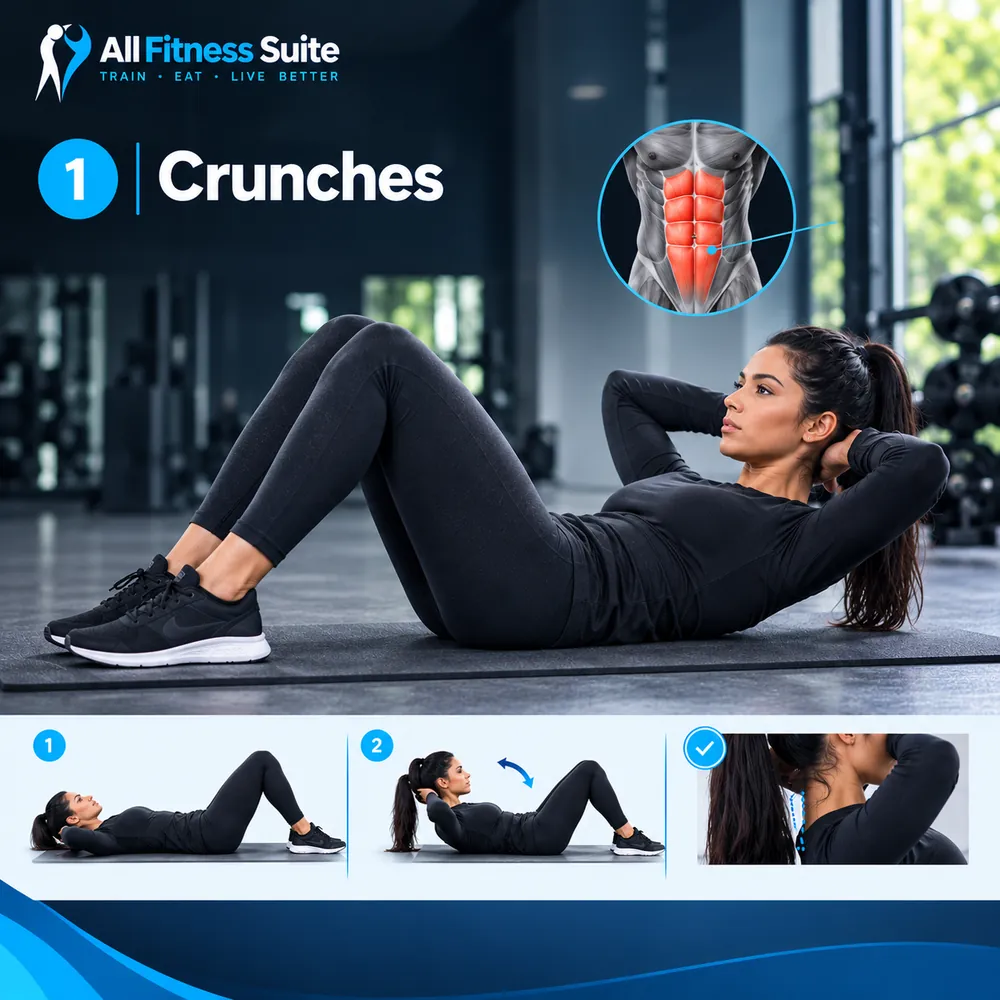
1. Crunches (Target: Activation of Rectus Abdominis)
Execution: Lie on your back with your knees bent and your feet flat on the floor. Tighten your abs and lift your shoulder blades a few inches off the floor, making sure you don’t strain your neck.
Rx: 3-4 sets x 15-25 reps.
2. Russian Twist (Focus: Oblique Activation & Rotational Control)
Execution: Sit with your torso upright and lean back slightly while keeping your back straight. Stand up . Rotate slowly from side to side . Control the movement . Feel the internal and external obliques working .
Prescription: 3-4 sets per side of 12-16 repetitions.
3. Leg Raises (Focus: Lower Abs & Deep Stabilizing Muscles)
Method: Recline on the mat with your legs extended. While performing this exercise, ensure that your lower back remains pressed against the floor as you elevate and lower both legs in a controlled way. To maintain good physical condition, flex your knees.
Prescription: 3–4 sets of 10–14 repetitions.
4. Bird-Dog (Posterior Chain & Spinal Anti-Rotation Focus)
Execution: Start on all fours with your spine in a neutral position. Extend one arm forward and the opposite leg backward simultaneously, keeping hips level and resisting the rotation of the trunk. Return to the starting position and repeat on the other side.
Prescription: 3-4 sets of 15-20 repetitions in total.
5. Side plank (Targets: Quadratus lumborum and lateral stability)
Execution: Support yourself with one forearm and the outside of your foot. Keep your body in a straight line from shoulder to ankle, hips up, and don’t give in to the temptation to let your hips drop.
Prescription: 3–4 sets of 12–16 repetitions per side, or use 20–45-second holds.
Physiological Foundations: Why Stability Trumps Raw Strength
Efficient core training involves more than just developing muscles. It also enhances endurance, strengthens spinal stability, and aids in safe movement during daily tasks and exercise. By combining training with appropriate nutrition, you can enhance core performance and achieve improved abdominal definition.
Core Endurance and Spinal Health
Studies indicate that core muscle endurance and maintaining stability are essential for spinal health and preventing injuries. The significance of each component can vary between individuals and is influenced by the activities in which you engage.
Isometric Stability and Injury Prevention
Exercises that strengthen the core to withstand movement—like planks, side planks, and bird-dogs—can enhance trunk stability. These movements pair effectively with workouts and can assist in controlling excessive spinal loading when proper form is utilized.

Progressive Overload and Abdominal Definition
Gradually increase training difficulty keep a diet and manage overall body fat to support abdominal muscle growth and visibility. Progressive resistance training stimulates muscle growth while a steady energy balance and good nutrition help reduce body fat over time.
Practical Nutrition and Recovery Guidelines
Developing a stronger core requires more than just consistent workouts. Adequate hydration, sufficient protein intake, and effective recovery enable the body to adapt to training, repair muscle fibers, and maintain consistent performance. Incorporating these habits into a fitness routine aids in long-term progress and reduces severe fatigue.
- Hydration Status: Keeping enough water in the body supports normal metabolic processes, nutrient transport and muscle function. Replacing fluids lost through sweat lets the body recover after demanding core workouts and keep performance at its best.
- Protein Intake: Eating high‑quality protein gives the essential amino acids required for muscle protein synthesis and tissue repair. Adding protein‑rich foods like eggs, fish, lean meat, dairy, legumes and soy helps build muscles when paired with steady resistance training.
- Active Recovery: Giving priority to sleep letting the body rest between tough workouts and adding light activities such as walking or gentle mobility exercises helps recovery. These practices control built‑up fatigue keep movement quality high and keep training consistent.
Ultimately, achieving an adequate level of effective core development relies on a combination of exercise, balanced nutrition, and proper recovery. Maintaining hydration supports muscle function, consuming sufficient protein enhances muscle recovery and development, and prioritizing sleep and rest allows the body to adapt to training requirements. Maintaining these habits consistently allows individuals to enhance core strength, improve physical performance, and strive for more defined abdominals over time.
References
- Mayo Clinic Staff. (2022). Core exercises: Why you should strengthen your core muscles. Mayo Clinic. https://www.mayoclinic.org/healthy-lifestyle/fitness/in-depth/core-exercises/art-20044751
- Physiopedia. (2026). Core Stability. Physiopedia Content. https://www.physio-pedia.com/Core_Stability
- Healthline. (2024). Importance of Core Strength: 11 Benefits of a Strong Core. Healthline Media. https://www.healthline.com/health/core-strength-more-important-than-muscular-arms