
🔬 Based on: Rossow et al. (2013) · 12-month case study of a drug-free professional bodybuilder
When a hyper-shredded bodybuilder steps onto the stage, it's like witnessing the ultimate expression of physical beauty. Those sculpted muscles and ultra-thin skin are the result of countless hours of hard work and unwavering discipline. But what really goes on inside the body of a natural athlete as they push their body fat down to such extreme levels? 🤔
To shed light on this, a groundbreaking 12-month study by Rossow et al. (2013) followed a drug-free, professional male bodybuilder, aged 26 to 27, through six months of contest prep and another six months of recovery. By gathering detailed data on cardiovascular health, metabolism, hormones, and performance, the researchers were able to capture the true physiological toll of reaching a remarkable 4.5% body fat naturally.
4.5% LOWEST BODY FAT |
27 bpm RESTING HEART RATE |
12 mo OF DATA TRACKED |
-61% ANAEROBIC CAPACITY |
|---|
The results challenge many widely held beliefs about fitness and reveal the incredible survival mechanisms hardwired into our biology. Here are the five most eye-opening physiological insights from this unique year-long study. 👇
❤️ Point 1: Resting Heart Rate Dropped to Starvation Levels (27 Beats Per Minute)
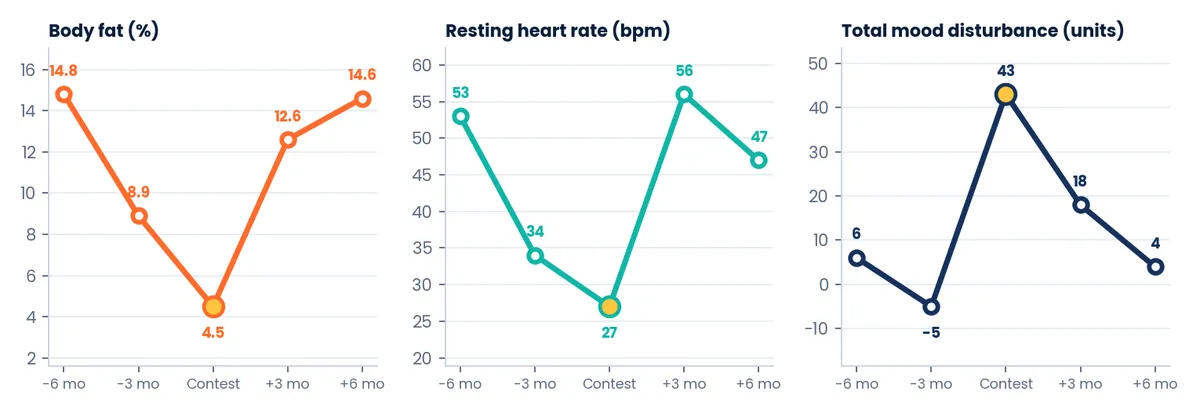
As the athlete trimmed his body fat from a starting point of 14.8% down to 4.5%, his cardiovascular system underwent significant autonomic down-regulation to save energy. His resting heart rate plummeted from a healthy 53 beats per minute (bpm) to an astonishing 27 bpm during the month leading up to the competition and the competition month itself.
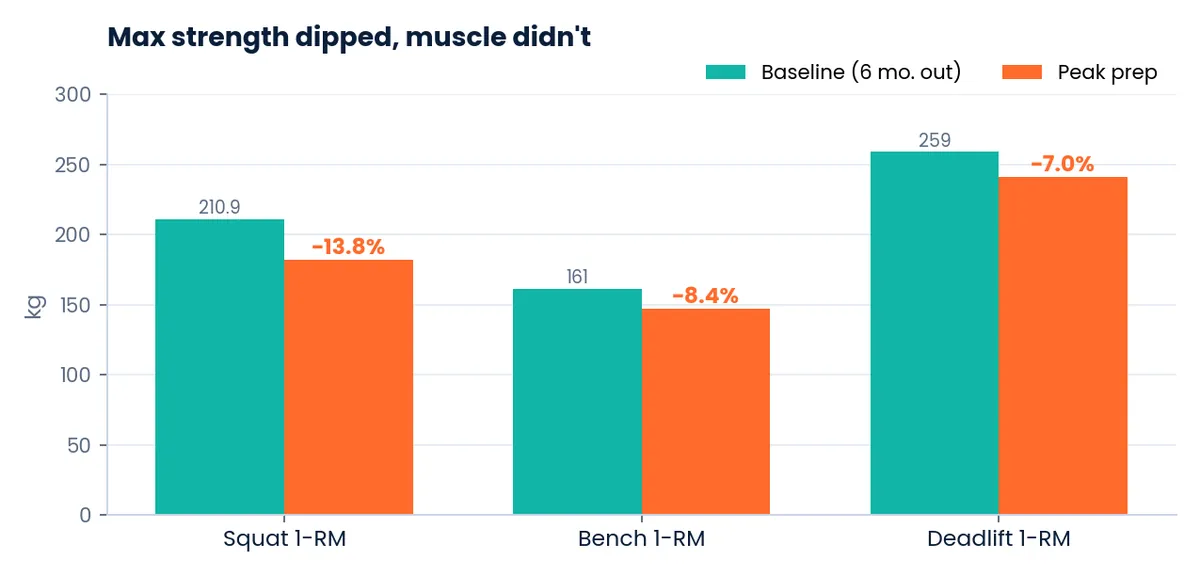
Even though the athlete managed to keep nearly all of his muscle mass, he faced significant drops in both maximal strength and high-intensity work capacity, largely due to a drastic depletion of intramuscular glycogen. Here's a quick look at the numbers: 📉
🏋️ Squat 1-RM: 210.9 kg → 181.9 kg (-13.8%)
💪 Bench Press 1-RM: 161.0 kg → 147.4 kg (-8.4%)
🔩 Deadlift 1-RM: 259.0 kg → 240.9 kg (-7.0%)
⚡ Anaerobic Working Capacity (AWC): 25.0 kJ → 9.6 kJ (-61%)
💡 Key takeaway
This stark contrast highlights that losing strength during extreme dieting doesn't always mean muscle tissue is breaking down. Instead, it's the severe depletion of energy sources and extended energy deficits that hinder glycolytic processes, cross-bridge cycling force, and high-intensity neural drive, even when the muscle volume itself stays intact.
😓 Point 2: Experiencing "Overtraining" Symptoms Seems to Be a Must for Hitting 4.5% Body Fat
In the realm of athletic performance, signs like increased catabolic hormones, mood swings, and declining physical output often indicate a dangerous level of clinical overtraining. During the preparation for competition, the athlete's cortisol levels shot up from 10.52 µg/dL to 21.07 µg/dL. Notably, researchers pointed out that this spike in cortisol mainly reflected an increase in fat breakdown for energy rather than muscle breakdown, which helps explain how lean body mass was preserved despite the stress signals.
2× CORTISOL · 10.52 → 21.07 µg/dL |
6 → 43 TOTAL MOOD DISTURBANCE |
4 → 22 FATIGUE SCORE |
19 → 5 VIGOR SCORE |
|---|
On the psychological side, the Profile of Mood States (POMS) painted a complex picture. Total Mood Disturbance (TMD) actually improved in the early stages of prep, dropping from a baseline of 6 units to -5 units over the first three months, thanks to high motivation and lower tension. However, as fat stores dwindled, the mood took a nosedive: TMD skyrocketed to 20 units by the month before competition and peaked at 43 units during the event, driven by a significant increase in fatigue (from 4 to 22 units) and a sharp decline in vigor (from 19 to 5 units). 🎢
🔄 Point 3: Physiological Recovery is Asymmetric (Hormones Bounce Back Quickly, Strength Takes Its Time)
After the competition wrapped up and the athlete started to refuel, his body kicked off the recovery process, but not all systems were on the same timeline. The autonomic cardiovascular and endocrine markers bounced back pretty quickly once energy levels were back up:
⚡ Quick Autonomic & Endocrine Recovery Within just a month, his resting heart rate shot back up to 46 bpm, and his blood pressure settled at a healthy 115/60 mmHg. Total testosterone climbed back to normal within three months (from 8.7 ng/mL to 9.91 ng/mL), and by the sixth month, his Total Mood Disturbance had fully returned to baseline (4 units). |
🐢 Slower Neuromuscular & Performance Recovery Body fat gradually crept back to baseline (14.6%) by month six. However, his bench press strength was still lagging at 150.1 kg (baseline: 161.0 kg), and his Anaerobic Working Capacity was still down at 19.4 kJ (vs. 25.0 kJ baseline). |
|---|
This difference in recovery rates shows that while quickly addressing an energy deficit can swiftly restore hormonal balance and autonomic function, getting back to full neuromuscular strength and cellular recovery takes a lot longer. ⏳
🏆 The True Nature of Natural Bodybuilding
Tracking this professional athlete over 12 months highlights the incredible discipline needed to achieve a contest-ready physique. It demonstrates that with the right nutrition and a solid resistance training plan, a drug-free athlete can maintain nearly all their muscle mass while achieving elite levels of leanness. However, it also sheds light on the physiological truth: hitting 4.5% body fat means pushing the body into a temporary state of dysfunction, marked by hormonal collapse, significant bradycardia, and reduced physical performance.
📊 Physiological and Performance Profile
Drug-free male bodybuilder, age 26–27, tracked across contest prep and recovery. The contest month is highlighted.
| Time Point | Body Fat % | Fat-Free Mass (kg) | Heart Rate (bpm) | Strength (1-RM) | Total Mood Disturbance |
|---|---|---|---|---|---|
| 6 months before competition | 14.8 | 87.65 | 53 | Squat 210.9 kg · Bench 161.0 kg · Deadlift 259.0 kg | 6 |
| 3 months before competition | 8.9 | 84.09 | 34 | Not in source | -5 |
| Month of competition (0) | 4.5 | 84.84 | 27 | Squat 201.9 kg · Bench 154.2 kg · Deadlift 249.9 kg | 43 |
| 3 months after competition | 12.6 | 85.68 | 56 | Not in source | 18 |
| 6 months after competition | 14.6 | 84.59 | 47 | Squat 212.3 kg · Bench 150.1 kg · Deadlift 259.9 kg | 4 |
✅ Bottom line
Natural bodybuilding is all about balancing visual appeal with internal health.
References
- Behnke, Albert R. "Quantitative Assessment of Body Build." Journal of Applied Physiology, vol. 16, no. 6, 1961, pp. 960–68. American Physiological Society, https://doi.org/10.1152/jappl.1961.16.6.960.
- Rossow, L. M., Fukuda, D. H., Fahs, C. A., Loenneke, J. P., & Stout, J. R. (2013). Natural bodybuilding competition preparation and recovery: A 12-month case study. International Journal of Sports Physiology and Performance, 8(5), 582–592.